Mental slot tested 2026: 96.65% RTP over 20,000 logged spins, xSplit maths and the 80x Autopsy buy
Nolimit City builds slots the way some studios build roguelikes: a small core ruleset, then a stack of modifiers that interact until the outcome space becomes enormous. Slotester has now put the studio's 2021 asylum-themed release through a full logged test, and the review of Mental shows the measured figures next to the studio's own numbers, with a free demo of the game sitting beside them.
For anyone who reads games as systems, this title is a case study in how volatility gets engineered rather than inherited. Nothing in the base paytable is generous. The money lives in the modifiers, xSplit, xWays, xNudge and the Dead Patient multipliers, tuned so that the average stays near 96% while single rounds range from nothing to four figures.
The definition block first. Mental is a Nolimit City slot released in 2021, played on five reels stacked 3-2-3-2-3 that open at 108 ways and expand as symbols split. The declared RTP is 96.08%, the volatility rating is high, the advertised cap is 66,666x the bet, and the Autopsy feature can be bought for 80x.

How is the Mental board built, and why does the paytable look so thin?
The board is deliberately small: 108 ways across five reels, with the top symbol, Patient-1, paying only 5x the bet for five of a kind and the organ symbols paying between 0.10x and 1.25x. On its own that paytable could not carry 96.08%; the modifiers do.
Each base spin paints between 1 and 13 positions with Fire Frames, and any symbol that lands inside one splits into two copies. Under reels two and four sit Enhancer Cells that open once 4 and 6 Fire Frames have been collected; an opened cell reveals an xNudge Wild, a plain Wild, xSplit, xWays, a Dead Patient or a Patient. From a design standpoint this is a resource loop: frames are the currency, cells are the spend, and the counters fill with no decision from the player.
xSplit, xWays, xNudge: what each modifier actually does
Three signature mechanics do different jobs. xWays turns one position into three symbols of a single kind and stretches the reel, so the ways count jumps. xSplit splits one symbol on every reel into two and then becomes two Wilds itself, which is why it sits behind most of the big base-game rounds in the test. xNudge is a stacked Wild that nudges into full view, and its multiplier grows by one with each step it nudges.
Two more pieces complete the system. Dead Patient symbols work in pairs: two of them uncover a Patient whose multiplier, anywhere from x5 to x9999, counts as that many copies of the symbol on its reel. And a Spider on reel two or four triggers Mental Transform, converting symbols into one of xWays, xSplit, a Wild, a Patient or a Dead Patient. The design lesson is that every modifier multiplies ways rather than adding flat payouts, so the outcomes compound instead of summing.
What did the Slotester test measure?
The lab ran the game for 20,000 ordinary spins in two sessions of 10,000, the first on 27 September 2026 and the second on 30 September 2026, both at EUR 1.00 on Nolimit City's official demo server, plus 100 purchases of the 80x Autopsy feature. Pooled, the spins returned 96.65% against the declared 96.08%, with an approximate 95% interval of 81.1% to 112.2%. Hits came on 34% of rounds, 108 natural features triggered, and the biggest single round paid 1,125x. All of this is data as of 13 October 2026, and the review page recalculates its headline figures whenever a further run is added to the pool.
| Figure | Printed in the rules | Logged over 20,000 spins |
|---|---|---|
| RTP | 96.08% | 96.65% (95% interval 81.1% to 112.2%) |
| Sample | not applicable | 20,000 spins, 2 runs, EUR 1.00 per spin |
| Hit frequency | not published | 34%, one paying round every 2.94 spins |
| Natural free spins | not published | 108, one per 185.2 spins (5.4 per 1,000) |
| Free spins payout | not published | mean 67.62x, median 50.55x |
| Max win | 66,666x, cited at 1 in 18,000,000 rounds | 1,125x, run 2, round 390 |
| Autopsy buy | 80x the bet | mean 0.98x of price over 100 buys, 77 below price |
| Longest dry streak | not published | 22 spins |
Two things stand out. The interval is wide, because a high-volatility game needs far more than 20,000 rounds to pin its mean down, and the page says so. And the declared value sits comfortably inside the band, which is the case for 133 of the lab's 142 tests.
Is xSplit really the engine behind the biggest base wins?
Yes, with one exception. In the first run 192 spins contained an xSplit, 1.92% of the series, yet they produced 30.38% of all base-game winnings, averaging 8.027x the stake while every other spin averaged 0.360x. Eighteen of that run's twenty largest base wins had a split in them. The second run repeated the pattern: 196 xSplit spins took 34.0% of base-game money at 12.066x each, and supplied 15 of the top 20, including round 4627, where the lowest-paying organ covered 432 ways over the full five reels for 456.3x.
The exception was round 390 of the second run, the 1,125x that tops the whole test. No xSplit and no open Enhancer Cell were involved. Two Dead Patients landed on reels one and two and both revealed the same Patient symbol carrying x50; with a plain copy of that symbol on reel three, the win counted 2,500 ways at 0.45x per way. One base spin outpaid every feature in the 20,000-round sample and made up 10.3% of the run's return.
How volatile is Mental when you stop reading the label and count?
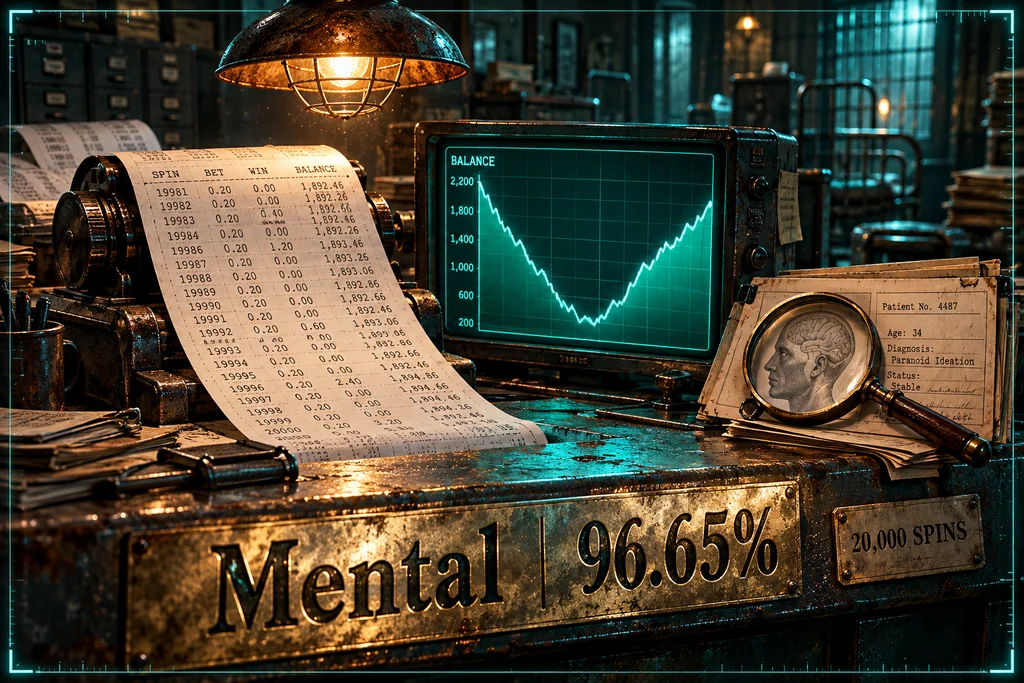
Very. Of the 20,000 spins, 13,201 paid nothing at all and a further 4,329 paid less than the stake, so the median winning round was only 0.55x. The longest blank stretch was 22 spins, the average 2.95. At the other end, 21 rounds exceeded 100x and exactly one passed 500x. The balance told the same story twice: the first session closed 1,628.8 bets down after bottoming 1,844.3 bets below its start on spin 8967, while the second never fell more than 94 bets under and closed 959.6 up.
The page also tracks bankroll survival across the pooled sequence. A 50-bet stake ran out at spin 121, 100 bets at spin 565, 200 bets at spin 841; the deepest drawdown measured 1,922 bets. In design terms, this is what stacking multiplicative modifiers on a thin paytable produces. The label says high, and the log explains why.
Autopsy, Lobotomy and the free spins ladder
Free spins in this game are a three-rung ladder. Autopsy Freespins open on three Scorpions, which only ever land on reels one, three and five: 8 spins to start, with an extra spin per Scorpion that was sitting in a Fire Frame. Inside the feature, as many as five new frames can be added each spin and they persist to the end. If a Spider lands during Autopsy, the rest of the feature becomes Lobotomy Freespins with one spin added: the Spider stays put, the Transform triggers on every spin, and the multipliers from Dead Patients are gathered up and passed to the Patients they match. Two Spiders, or a fresh one during Lobotomy, open Mental Freespins, in which a collected multiplier holds on to its full Patient count after every transfer.
Measured against that ladder, the 108 natural features paid, from their free spins alone, an average of 67.62x and a median of 50.55x the stake, 37.8% of all money returned. Seventeen cleared 100x and four stayed under 20x. The largest were 280.4x on round 9533 of the first run and 337.5x on round 4769 of the second. Eleven natural features finished in Lobotomy, and those averaged 91.36x and 89.24x per run against 65.19x and 60.90x for the ones that stayed in Autopsy. The top rung was reached once in 208 features, natural and bought together: round 5846 of the second run, which opened as Autopsy, climbed through Lobotomy and paid 274.05x. The longest waits between features were 901 and 1,011 spins.
Is the 80x Autopsy bonus buy worth it?
On this sample it came close to break-even without reaching it. One hundred tickets at EUR 80 returned EUR 7,866.70 against EUR 8,000 spent, 0.9833x of the price, 0.9505x in the first run and 1.0162x in the second. The median ticket paid EUR 49.75, and 77 of the hundred failed to cover their cost. What the purchase ledger shows:
- 23 of 100 tickets broke even or better, 9 paid at least twice their price, 3 passed 5x.
- The best ticket, number 49 of the second run, upgraded to Lobotomy and paid EUR 934.70, 11.68x; the other 99 returned 0.8753x between them.
- The worst ticket paid EUR 6.30, 0.08x of its price.
- Bought features lasted 8.6 spins on average; 87 of 100 ended after 8 or 9 spins.
- Twelve purchased tickets upgraded to Lobotomy, averaging 71.20x in the first run and 171.76x in the second.
- No bought feature paid nothing.
The design question is whether the price matches the natural rate. One ticket costs 80 ordinary stakes, and the game handed out a natural feature roughly every 185 spins, so the buy compresses waiting time rather than changing the maths. The menu also lists Lobotomy priced at 230x, the top feature at 1000x, and a 232x Lucky Draw; the purchase series used only the standard 80x option.
Where does this test sit in the Slotester Lab register?
Slotester Lab keeps every test it has published in one sortable table on its home page, https://slotester.com/, which on 13 October 2026 listed 142 slots, each with its measured and declared RTP, how often the bonus came, the largest round in the log and what the purchases returned. Across the register the average measured figure is 96.5% and the average printed one 96.39%, with 76 tests coming in below their declared value. This game's 96.65% therefore lands a little above the lab's typical result.
Each run on the review page has its own downloadable spin log, rounds CSV and raw server journal, all with SHA-256 checksums, so the 96.65% can be recomputed from the files rather than taken on trust. Next to the figures sits the free demo: the official Nolimit City build, loaded in the browser without registration, on virtual credits, so the mechanics above can be watched on slotester.com for nothing.

Responsible play: what a measured 96.65% does not promise
A measured return describes one sample on a demo server. The 95% interval runs from 81.1% to 112.2%, which means a different session of the same game can legitimately land anywhere in that range, and casinos are under no obligation to reproduce the lab's figure. The demo plays with virtual credits and no money changes hands; real-money play is a paid entertainment product with a built-in house edge, not a way to earn. Slot games are for adults aged 18 or over, or the legal age where the reader lives. Players who do stake real money should decide on a spending ceiling and a session length before they start, treat the 1,125x round as a rarity rather than an expectation, and stop when the ceiling is hit.
Mental slot: quick answers
What is the real RTP of Mental?
The game declares 96.08%. Across 20,000 logged demo spins on 27 September and 30 September 2026, the lab measured 96.65%, with an approximate 95% interval of 81.1% to 112.2%. The individual runs returned 83.71% and 109.60%, so the pooled figure is the only one worth quoting.
How volatile is this slot?
High by the label and high by the log: 66% of spins paid nothing, the median winning round was 0.55x, one run lost 1,628.8 bets while the other gained 959.6, and the deepest drawdown reached 1,922 bets.
What is the max win, and how close did the test get?
The advertised cap is 66,666x the bet, which the rules say was simulated at one in 18,000,000 rounds. The biggest logged round was 1,125x, produced in the base game by a pair of x50 Dead Patients.
Is the Mental bonus buy worth it?
Over 100 purchases at 80x the mean return was 0.9833x of price, the median EUR 49.75 on an EUR 80 ticket, and 77 tickets paid less than they cost. One ticket in the second run returned 11.68x; without it, the other 99 returned 0.8753x.
How often do the free spins trigger naturally?
108 times in 20,000 spins, once per 185.2 spins on average, 49 and then 59 across the two runs. The longest gap was 1,011 spins, and the free spins paid a median 50.55x the stake.
Where can the Mental demo be played for free?
On the review page at slotester.com, which embeds the official Nolimit City demo. It runs in the browser on virtual credits, needs no account and includes the Autopsy purchase menu.
Is the game rigged?
The test cannot prove fairness and does not claim to. It shows that the declared 96.08% lies inside the measured interval, that the runs took place on Nolimit City's own demo server, and that every round sits in a published log with a checksum.